CHINESE SCIENTISTS MAKE NUCLEAR FUEL-EMITTING 3D PRINTED CERAMICS BREAKTHROUGH
Researchers at the Chinese Shenzhen University and Southwestern Institute of Physics have developed a means of additive manufacturing ceramic structures that emit nuclear reactor fuel.
Utilizing lithium-loaded ceramics and DLP 3D printing, the team have been able to create ‘breeding blankets’ that self-sufficiently generate tritium, a vital element of the nuclear fusion process. In future, the scientists’ cellular devices could be used as a more efficient version of the pebble beds seen within experimental reactors, helping advance the technology towards addressing global energy shortages.
“[Our] structures possess high phase purity and suitable and tailorable effective ‘packing fraction’ for [tritium] breeding applications,” said the scientists in their research. “The unique advantage of flexible control in design and manufacturing of 3D printing, may pave a promising way for greater possibilities to engineer novel tailored high-performance tritium breeder structures, used in nuclear fusion technology.”
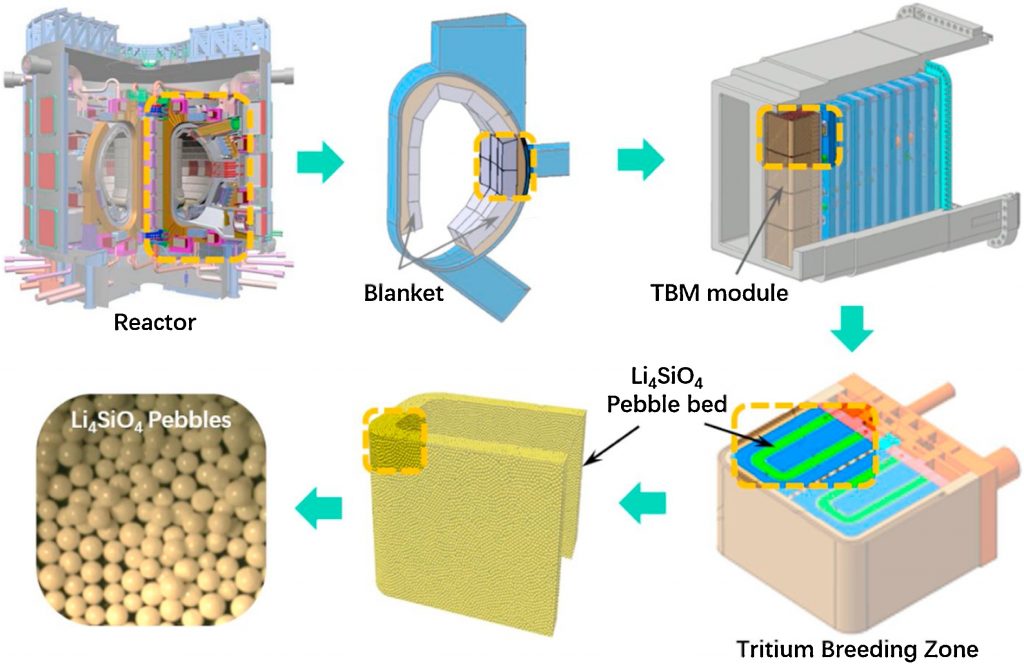
Tritium’s critical nuclear role
Although nuclear power offers potential safety, cleanliness and sustainability benefits over many existing energy sources, the technology’s progression relies heavily on the R&D conducted within experimental reactors. During such research, carrying out the so-called ‘D-T reaction,’ in which deuterium and tritium are consumed as fuels, is vital to converting nuclear fusion into extractable energy.
However, while deuterium resources can be derived from seawater, tritium can’t be found naturally on Earth, thus its production has become critical to advancing the performance of nuclear reactors. At present, the hydrogen isotope is often collected by lithium-containing ‘blankets’ that effectively clash with the neutrons generated by D–T reactions inside a reactor’s core, producing tritium in the process.
Of these absorption devices, tangentially-packed pebble beds are most commonly used to facilitate the release of reactants, but these can be prone to cracking and causing instability. To develop an alternative to pebble beds with greater tailorability, the Chinese scientists have therefore adopted 3D printing, and created an integrated tritium-breeding solution with less internal contact points, thus reducing its vulnerability.
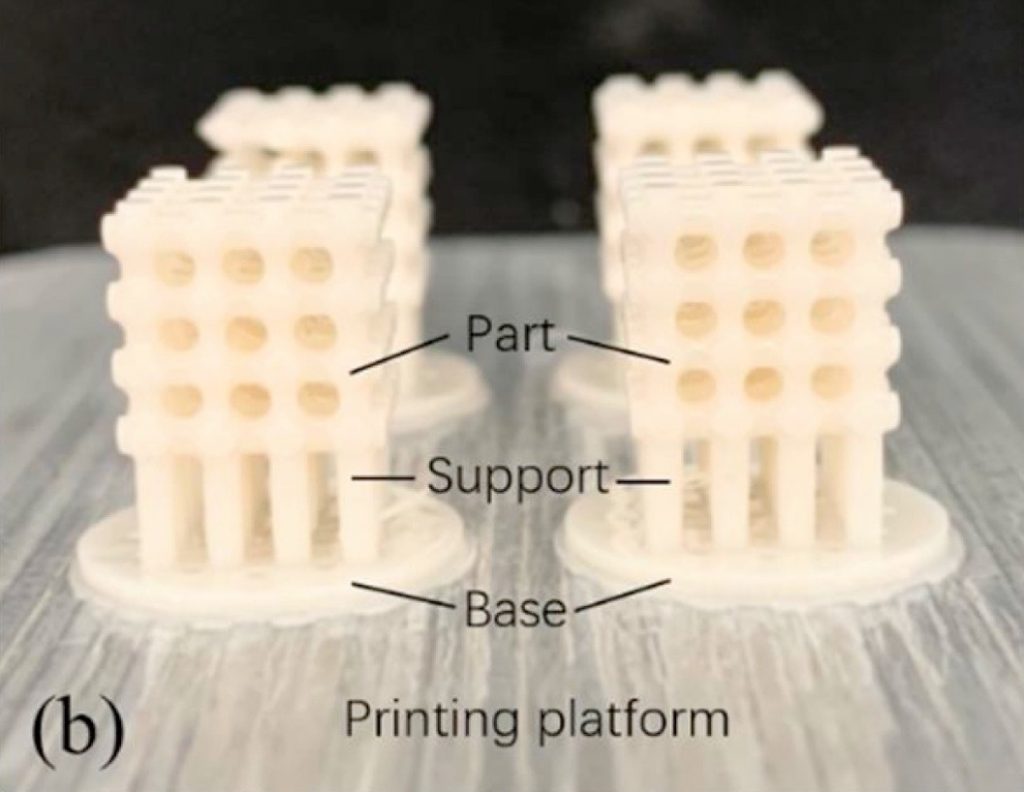
3D printing a novel fuel ‘bed’
Given that their experiments would take place at the relative humidity of room temperature, the scientists needed to develop a material that wouldn’t react to water vapor, and lose its phase purity. To accomplish this, the team mixed lithium, ceramic and silicon monoxide into a resin-based ceramic ‘slurry’ inside a glove box filled with an inert argon atmosphere.
Once their slurry was ready, the researchers used a commercial Ceraform100 3D printer to photopolymerize it into cellular prototypes, before debinding and sintering them during post-processing. The resulting intersecting 10 × 10 × 10 mm3 structures featured a volume ratio or ‘packing fraction’ of 60%, similar to that seen within current pebble beds.
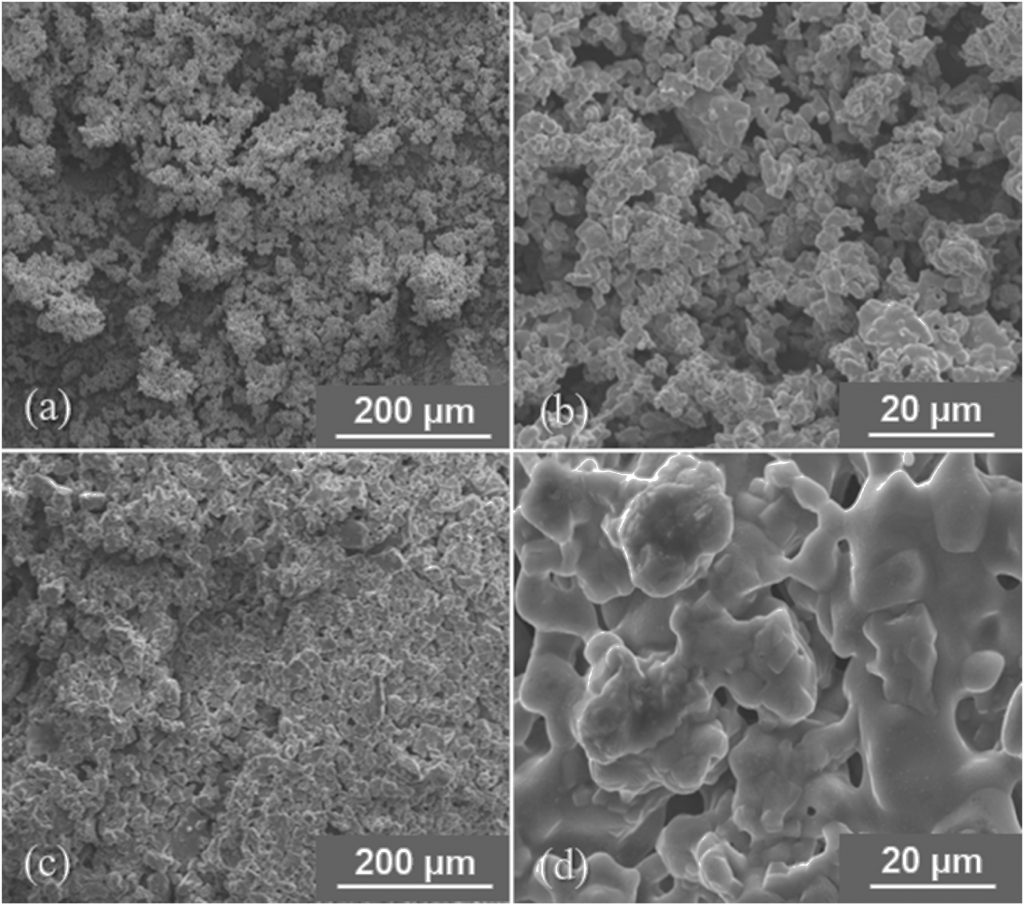
Additionally, although the team’s specimens were initially yellowish in appearance, the final parts featured a more conventional white color, after the slurry’s organic content was burnt out during debinding. Describing the models’ dimensional accuracy as “fairly good,” the scientists later found their shrinkage to be uniform, and through the use of MES imaging, that they were free of cracks at a microscale.
As a result of the “defect-free structural features” exhibited by their prototypes, the team concluded their novel 3D printing approach to represent a “promising” development in the production of tritium breeding structures, and an “attractive alternative” compared to the traditional pebble beds seen within current experimental fusion reactors.
评论
发表评论